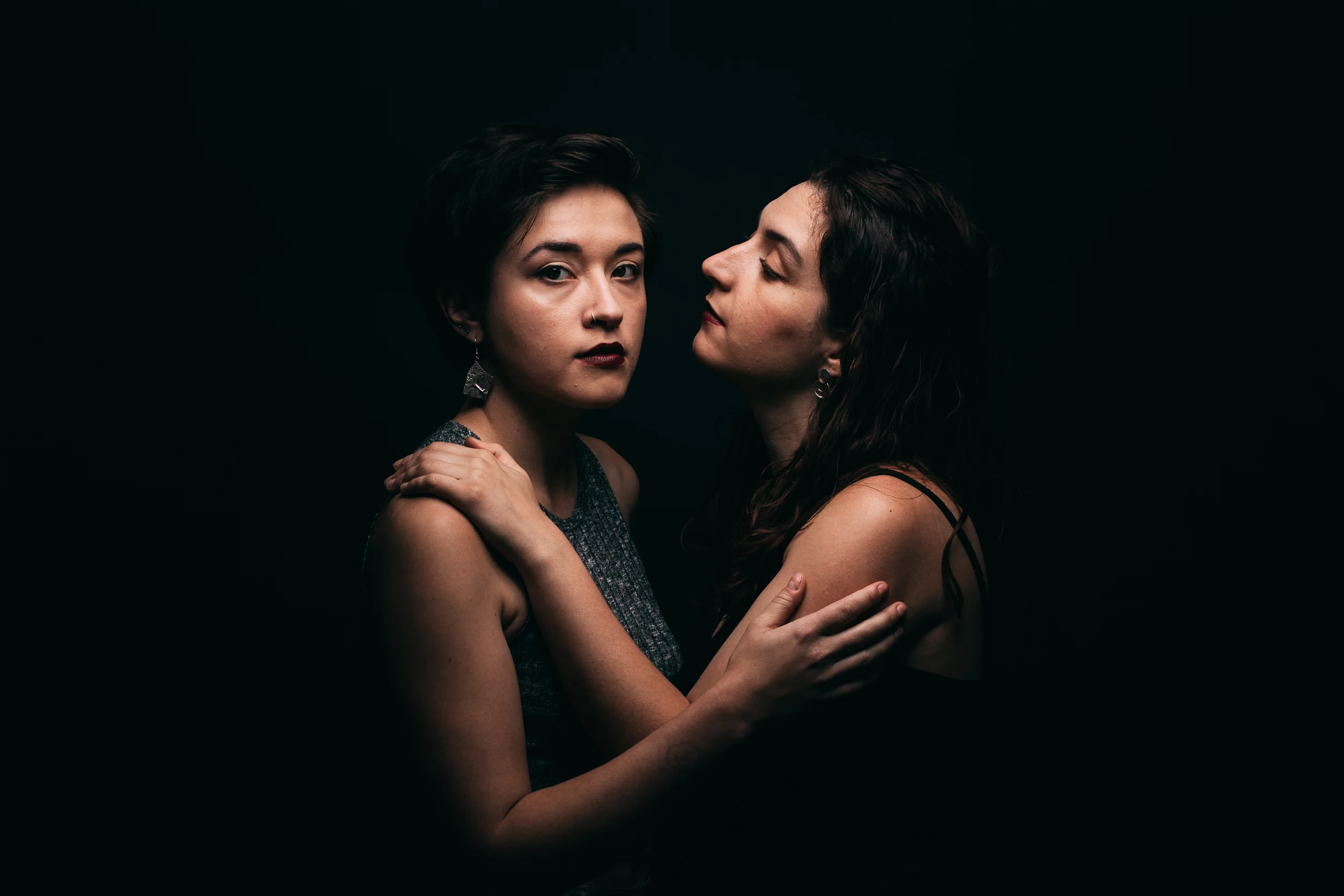
OHMME's Alliance of Exploration
Story by Benjamin Levine • Photos by Michael Salisbury
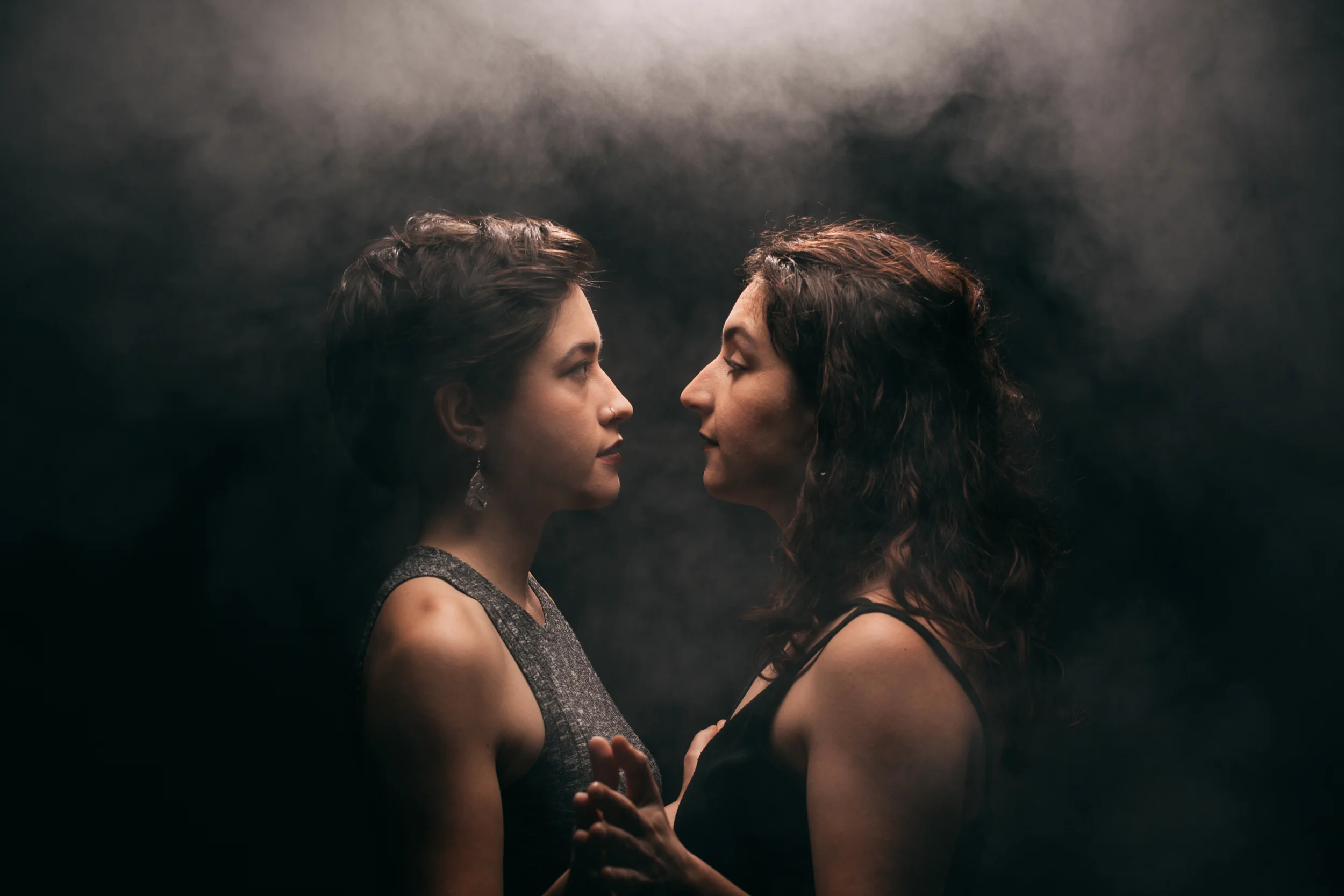
It was cold and rainy in Pilsen when we met the women of OHMME. Macie Stewart and Sima Cunningham entered the studio – composed, sorting themselves out before starting the photoshoot. They laughed between striking poses, creating strong images while enjoying the process. The shoot wrapped up and we sat down over a glass of whiskey.
OHMME is self-described as an experiment, something they weren’t sure would work. We ask them, “What have you guys learned so far in the experiment?” Stewart replies, “We like to play louder than we thought we did.” “We really like to play guitar.” Cunningham adds, “I think that we’ve learned about letting go of certain things… and that we’ve both learned to commit to where we are in the present moment.”
“The band feels a little bit like an uncontrolled substance, but in a really exciting way.”
Ironically, at the present moment, OHMME is on the verge of breaking out onto the national stage. For the past two and a half years, the group has played shows throughout the United States while anchoring themselves in the world-renowned improvised music scene in Chicago. They’ve built a solid reputation for their music and momentum, participating in many projects and initiatives around the city. They are currently in the midst of preparing a vinyl re-release of their celebrated eponymous EP, a decision driven by their recent name change (originally HOMME) as well as their intention to give the music a second, stronger push beyond that achieved by the original self-release.

OHMME creates beautiful and powerful music, driving the familiarity of folk music into complex vocal exchanges with a healthy amount of noise. The result is aurally intriguing and inviting without pulling any punches when it comes to complexity. OHMME trusts the listener to give them space for sonic exploration while staying in their wheelhouse. The songs have staying power. The technical execution is top-notch.
What makes OHMME so special though, is the relationship between Stewart and Cunningham. There’s an palpable degree of comfort between them that supports the musical architecture as they wrangle with experimental risks. Despite they’re being strong musicians, they retain a level of vulnerability to this kind of free creation that demands enduring trust to accomplish consistently over time. They are able to explore creative ideas together, facilitated by a musical understanding that allows them to communicate openly and effectively. Stewart says that they, “just want to try things that are new and interesting,” painting the project as an exploratory vessel for wandering minds. “The band feels a little bit like an uncontrolled substance,” says Cunningham, “but in a really exciting way.”
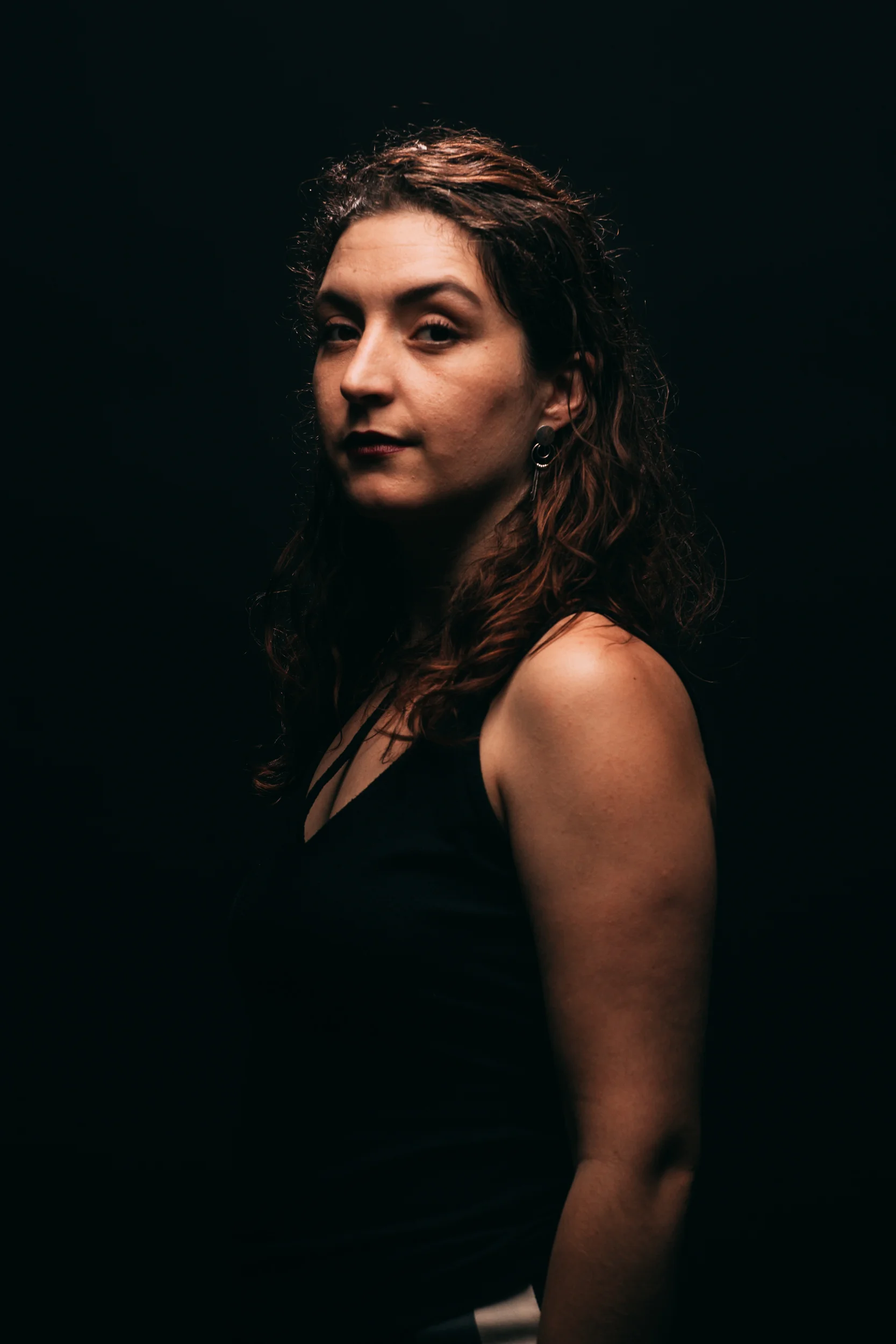

The two approach songwriting from an individual point of genesis, where one will introduce an idea to the other, and then they build on it together. While they play together often, it is not necessarily open jamming that kick-starts their creative process. Instead, they like to consume art and experiences together and create from there. When discussing their songwriting, Cunningham says, “A lot of the creative process happens when we go to a show that we’re both really inspired by and we buy the record. Then we listen to that record together and we’re like ‘let’s try playing that’ or ‘like oh that really got me wanting to try some of that’ and that will spiral into an impetus for us to get together and play around with a new idea.” She continues, “This band feels like a really great funnel for any idea that we encounter. It’s very much an exploratory project.”
Exploring new artistic space requires a strong partner on the same page, and their friendship is the backbone of OHMME’s ability to dive in. Stewart says, “it makes the creative process more intimate if you are that close with your writing partner and can listen to music together and create something out of that.” It is a rare alliance that seems built out of common roots, mutual respect, and the shared enthusiasm to push each other to creative peaks. They have been shoulders to cry on for each other as much as they have been each other’s most demanding critic, giving their performances a feeling of intimacy in the midst of impressive showmanship, like a quiet table in a popular restaurant.
None of this works, however, without a certain level of literacy, a shared language that binds independent spirits. Cunningham and Stewart are expert musicians that honed their skills over many years. Stewart took up piano at age 3 and Cunningham was a member of the venerated Chicago Children’s Choir from age 6 to 18. Their classical training generated a strong work ethic in both, so there’s never a lack of time or dedication for a project.
Accomplished musicians are challenged to find partners that can push their boundaries, but Stewart and Cunningham appear secure with each other as creative partners. Cunningham says, “I felt like whatever tools we were going to give ourselves was going to turn into something that we could meld, mold, and turn into and make what we wanted of it. I’m really glad because I feel like it was a challenge for both of us, but both of us are used to challenges and have been working really hard all of our lives to be able to play music well. What it just allowed us to do is relax, a little bit, into ideas.”
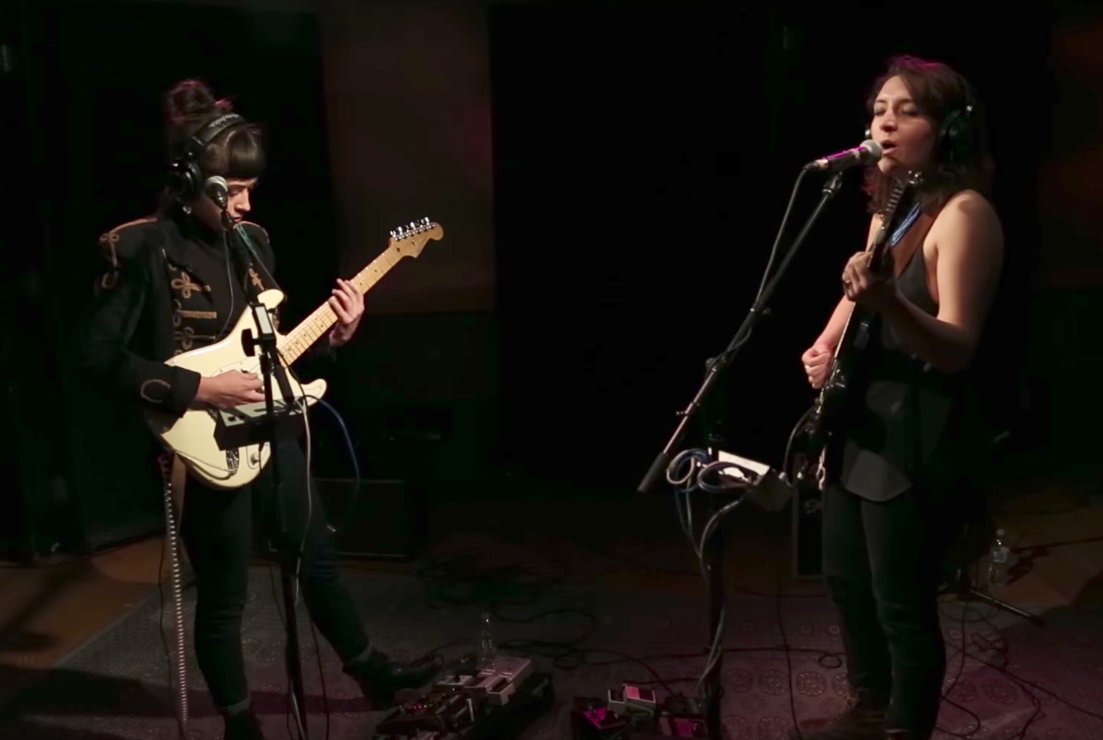
Ohmme perform on Audiotree Live, February 17th, 2016
While they operate on the same high level musically, much of their success may have to do with the timing of their collaboration – both artists seem to have arrived simultaneously at a similar direction artistically. “This band really started at a moment of transition for us,” says Cunningham, who had recently moved back to Chicago after spending her college years in New York City. After coming home, she says, “[I] had to find a whole new world of friends that I was spending time with, and Macie was a big part of that.” They had both experienced a lot and understood their power as musicians, but were looking for something that would stimulate them as artists.
It was through Chicago’s improvised music scene that they found their creative needs nourished. They solidified their friendship by spending time at the places where this music could be heard. It was a “new world of music that [they] were both drawn to,” one that encouraged them both to abandon the conventions of classical music and rock in order to activate their abilities in ways that might be completely off the rails.
The improvised music scene in Chicago is full of heavy-hitters, accomplished musicians with high standards for collaboration; Cunningham and Stewart fit right in despite their more conventional musical roots. They found a community capable of facilitating their plunge into uncharted waters, and gave back to it through music projects like The Few and the concert series I Hear Voices. They are a visible and positive influence to the people with whom they associate, while undeniably hustling and advancing their careers with care.
As much as they may credit the improvised music scene with pushing them to learn guitar and experiment, it would be foolish to peg Stewart and Cunningham to this scene exclusively. Their level of talent and drive is hard to keep under wraps, and because of this they have worked in various pockets of Chicago’s diverse music scene. Cunningham says, “We both feel really lucky that we have the ability to work in so many genres in Chicago.” Between them, they’ve worked with big names like Richard Thompson, Chance The Rapper, Ken Vandermark, Vic Mensa, and Jeff Tweedy.
If you’ve followed the music scene in Chicago over the last 5 years, you’re likely to have, at the very least accidentally, encountered their music. They function like quiet bridges holding different parts of the scene together, allowing for improvised to influence hip-hop and rock to flow into jazz. They are the kind of ambassadors between genres that are critical to fostering community and creating more interesting music through cross-pollination. When talking about the Chicago music scene as a whole, their perspective sees all the intersections. “Everyone kind of knows each other but we’re all in different realms of music, but it’s still very much attached.” Stewart says. “It’s kind of even more interconnected than I think people will admit.” adds Cunningham.
“It makes the creative process more intimate if you are that close with your writing partner and can listen to music together and create something out of that.”



Their strong sense of community and giving back to those around them emerges as a strong value for both women. In that spirit, they both enjoy spending time with children and prioritize working with them. With any kind of work, there is typically some personal benefit, and time with children is both decompressing and reflective. Cunningham says, “there are definitely times where both of us can get really stressed out and both of us really, really benefit from just laughing our asses off, you know? And I think hanging out with some kids is a great way to laugh and have a good time, or just even hanging around kids and that bring a childish side of humor to ourselves is just really awesome and healthy.” Stewart teaches young children music and says, “I feel like teaching children helps me discover so much about the way that my own musical brain operates because you have to break down your own playing in order to explain it to children.”
Sima Cunningham and Macie Stewart have strong roots in Chicago, and they care for their communities in their own quiet ways. Through these roots, they’ve been a part of many significant music projects in the city’s history and, through a desire to evolve as musicians, developed a unique sound that seems capable of sustained growth. They have explored together, relying on each other’s developed musical talent to sew ideas into musical cloth, past points where it looked as though they would fall apart.. As one who appreciates music, it is satisfying to witness a creative partnership that deserves the attention it’s getting. Hopefully that attention will leave OHMME with even more ideas with which to grapple and more experiences to reflect on together.