

Words and Interview by Ray Mestad
Photography by Micheal Salisbury
Design by Kevin Shark
Our thoughts are our own, for better or for worse. Sen Morimoto, whose profile has exploded onto the national music conversation with his unpredictable project Cannonball!, uses music to direct his thoughts, both good and bad, into something productive. As a songwriter, Sen externalizes his introspection, resulting in a deeply personal glimpse at his stream of consciousness as he leaps from one thought to the next. His lyrical stylings of free association paired with his jumpy hip-hop jazz beg the question, what is on Sen’s mind?
Today, Sen has been daydreaming about some serious interpersonal conflict he’s been dealing with. “I was thinking about this squirrel that lives outside my apartment...my other roommate started growing tomatoes on our porch that the squirrel ate all of...I came home yesterday...and it was like a murder scene, there was soil everywhere, it had eaten half the avocado and just left. So I was thinking about, how could we stay on good terms with this squirrel, but not keep letting it walk all over us? The squirrel is such a rude neighbor and I didn’t think of anything, we’re gonna have to kill it.” Sen jokes - he’s about the nicest guy one could come across and wouldn’t hurt a fly, much less a squirrel.

There’s plenty of squirrels where Sen’s from, the forest and farmland of Wendell, Massachusetts - “I spent a lot of time walking in the woods and doing stuff outside.” He’s lived in Chicago, the first city he’s called home, for 4 years now, and still finds moments of adjustment. Sen has love for the countryside - “everything just feels realer, in a weird way. Like the air, even. Everytime I get home, I stick my head out the window in the car, and get that air in my face. It feels different.” But, Chicago is where Sen has found a second family in the local music community. “The main thing is people, really. That’s something I appreciate about Chicago and why I’m still here, is that I love the people I’ve met and have become a part of my life. That’s the trade off.”
Sen has accomplished a lot since moving here. He’s been a local live staple for a minute now, albeit with a much smaller live setup. In the last year he joined forces with Sooper Records (and is now part-owner) and since then it’s been off to the races. Cannonball! was released to critical acclaim, and he’s since received praise from 88Rising, Pitchfork, Fader, Complex and more.
“So much of it is inside of you, whether or not you plan it out.”

His earliest music memory is singing the music to 90’s Tom Hanks movie ‘That Thing You Do’ in the car with his family. There’s also a memory of learning the blues scale from a band teacher when he first started learning sax at ten years old. “He right away showed me the blues scale, and was like, ‘just make something up’, over these changes. It was really crazy to be playing a new instrument, and not be learning a piece of music but just letting it come out of you. I was just playing the notes in the scale, didn’t even know what I was doing, but because it’s set up a certain way it just sounds good. That changed a lot for me, for how I thought about music. So much of it is inside of you, whether or not you plan it out. A really well written symphony is potentially only as good as something some guy pukes out of his horn one night and never does again.”
Sen also looks back on his time studying with Jazz legend Charles Neville (those Nevilles). Neville taught Sen how to translate the “lyrics” of a song into sound. “He was always talking to us about expressing what the ‘lyrics’ of a song are supposed to express...through melody, and spacing and your choice of tone...you shouldn’t be taking up space in a song saying the wrong thing. That’s not your place to do that. You’re playing this ballad that’s really sad, you shouldn’t just be like shredding.” Neville was teaching Sen the ability to divulge his inner monologue through the songwriting that now sets him apart on tracks like “People Watching”. Now Sen writes music as an open book. “I feel like the music lyrically and sonically is more vulnerable than I just naturally am. Even people who are really close to me, I don’t really talk like that to people. It’s almost like diary entries, you know.”
Expression through music is practical for Sen. When he was younger, his mind was a place where he used to “get caught up, really paranoid. People’s intentions, what life is going to be like,” a potentially paralyzing rabbit hole to explore, but Sen found a solution. “Making music directs that, it channels it into something that feels productive and can distract me while that’s happening.” Though making music turns the muck into something positive, “it doesn’t really take me out of it.” Listening to music, on the other hand, “really helps me get out of that. You’ve just got to know your songs, you need your playlist.” Listing them off, Sen’s got “your disassociated playlist, your manic playlist”, he says with a grin. A fan of artists like The Carpenters, Alice Coltrane, and Happy End, “It doesn’t feel like it’s gonna help, but then you put on a jam and you’re like ‘wait a minute…dancing really helps.’
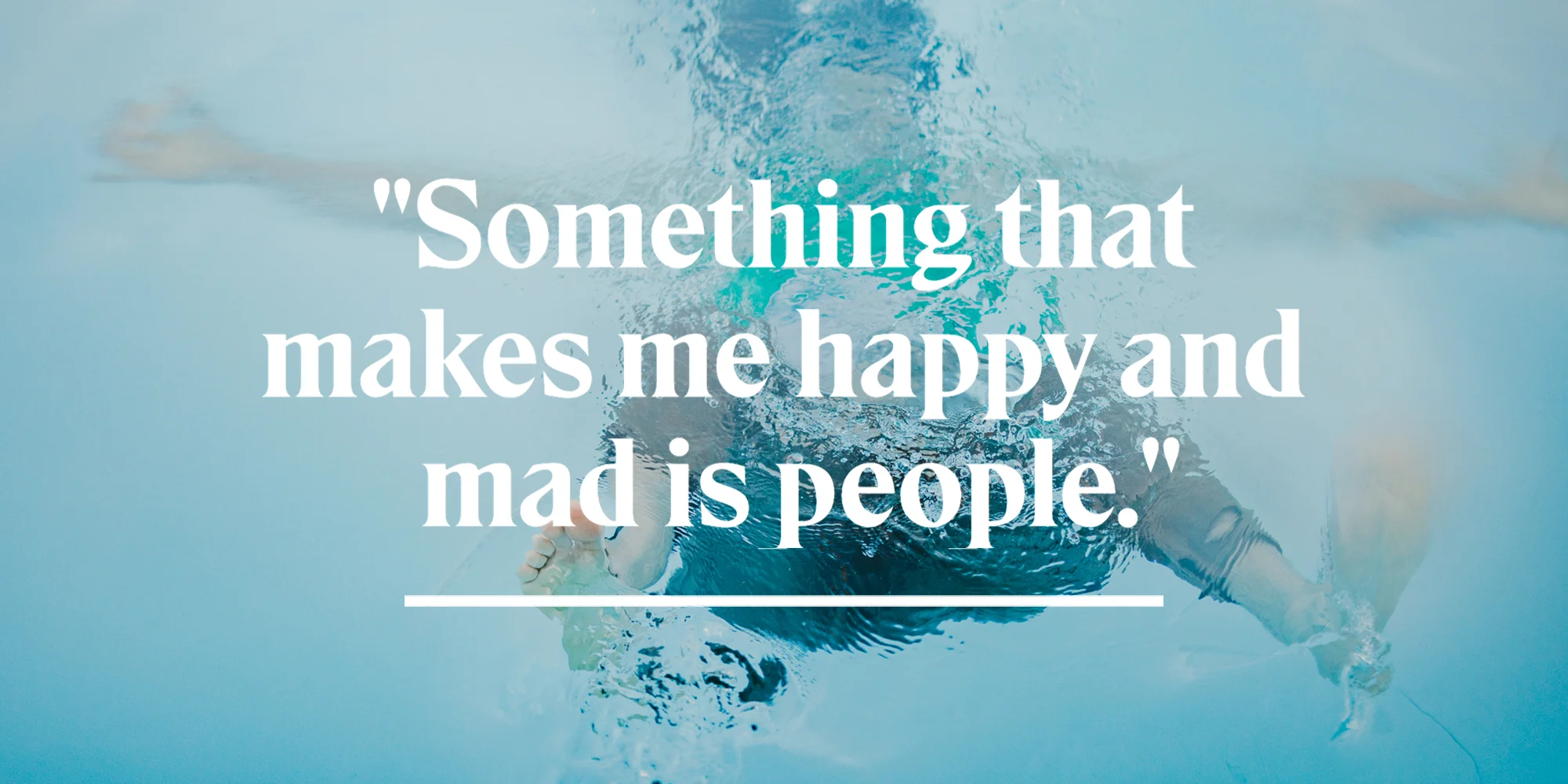
The world both exhausts and inspires Sen. Like the pros and cons of living in Chicago versus living in Wendell, “something that makes me happy and mad is people. Sometimes it’s just like why would this person act this way? It’s not even anger at them, it’s just confusion at how people’s minds work...at the same time, sometimes people will really astound you with how caring or attentive they can be. It really inspires you…”

It is through Sen’s curiosity and appreciation of people that he connects with them, in spite of any introversion or weariness. “I ask questions...it’s a new trick and it’s really helping. Or I’m just down to sound stupid or make a fool of myself...you just gotta make a fool of yourself a little bit so you can ask all the questions you want, then you become the best version of yourself by soaking it all in.”
That same philosophy, that “you become the best version of yourself by soaking it all in”, applies to music as well. By finding the truth in interactions and presenting himself in full, his music is in a constant state of growth. “Most of the time people’s music only ends up expressing one side of themselves, because that ends up being what people like and they feel like they have to keep doing that...that’s a certain pressure you start to feel, ‘people are expecting this from me’...I try to balance it throughout the record. Times when it’s really open, times when it’s very cold and kind of angry on purpose. On purpose in the sense that it’s something I’m showing on purpose because I think that...people are complicated like that. Even if it’s not something I feel all the time...it’s not always just one thing.”

Sen’s ideal day, emphasis on ideal, would be one with curiosity, discipline, and firmly rooted in the present. “I never do this, but if I woke up early, work on some music first thing, make some breakfast, then go do something new. Maybe go see some nature I haven’t seen, or see some crazy...sculpture? I don’t know! A temple. Come back, have dinner. Work on music again.
And no conversations about what’s going to happen after that day. It’s impossible! But that’s the ideal.
Sen’s admiration for people’s multifaceted nature of people is clearly resonating across the world, starting with a show coming up this Friday in Tokyo. ”Yeah, I’m stoked”, he says. “I’m flying my dad out, my brother’s gonna be there. I’m gonna see my grandma and aunts and uncles that I haven’t seen in a long time...my family’s not even seen me perform like that before. That’s gonna be really crazy, I’m probably going to have a meltdown”, Sen predicts before bursting into laughter. And what could be more indicative of Sen’s music and mind than laughter at the thought of a breakdown?
– R.M.